Tuesday, March 31, 2009

Peak Unsustainability?

This is one hell of a moment in history.

It's interesting in how the forum is going along, and the level of keen interest that's been generated even in one short week. I really sense, and I'm sure a lot of you do too, that we're living through a unique, even epic time. There's still a lot of confusion and denial out there floating around, and the fear of what's ahead explains a great deal of all that, perhaps even excuses a bit of it. No matter, what's coming is coming and rather than debate it's time to prepare.

The synchronicity of the moment is so shockingly unlikely on one hand--and so obviously predictable on the other that one cannot help but be a bit bewildered. We're seeing something I guess I'll call Peak Unsustainability for lack of a better term. Isn't it more than a little crazy that the housing market would collapse, primarily because people overbought, assuming an obviously unsustainable level of asset appreciation would continue forever? At the same time, they bought huge vehicles, assuming an obviously unsustainable supply of near freebee fuels would pour out forever? At the same time banks decided that they could carry a seemingly unlimited amount of debt on their books, assuming that they'd be able to float an obviously unsustainable amount of leverage forever? At the same time, of course, agricultural regions around the world begin to suffer a permanent drought, brought on by soil loss and the destruction of aquifers--and policies and practice that seem to by and large assume you could pump water at whatever rate you wanted to out of that well, in an obviously unsustainable manner--forever? The list goes on and on and on--in fact, one finds few individuals, or industries, or nations even, that haven't completely ignored their "balance sheet" and haven't run up completely unservicable debts not only in the realm of finance, but against our ecosystems, our croplands, our climate, even the integrity of our communities, institutions and personal relationships--the wealth and common good and even good will and trust has been completely looted. And to make matters worse? All of this wealth was squandered--tossed away on idle entertainments for the mega wealthy, trinkets for the rest of us, and, oh, I guess we got a couple of sex flicks out of Paris Hilton. . .

Obviously, key to to the lack of sustainability in the past was the complete neglect and even willful evasion on the part of most everyone in keeping good books. The amount of credit received either from bad loans or squandering natural resources was vast, but by and large kept in those mysterious "off balance sheet" assessments that now need to get valued. . .and so the response? Attempt to keep the party going by trying to squeeze even more blood out of that wrung out turnip. . .print money and expand the economy! Growth! As if this policy isn't obviously unsustainable and will only drag us deeper into the hole--but certainly patent unsustainability hasn't restrained anyone in the past, and it looks at this point that pumping that well will continue with bigger and bigger pumps until only dust comes out. . .

We have a lot to learn from this tendency. First, we must personally keep a rigorous accounting of our own practices. It's going to matter. Not only is unsustainable practice unsustainable, it's about to become rapidly and increasingly unaffordable, and as such no longer an elective for most. This will be a very big change in how things are done, oh boy--especially as we wind down a whole lot of people are going to find that they were sold out.

And they aren't going to be happy about all that.

Monday, March 30, 2009

Nexus

Any of you ever actually catch a banshee by the tail before?. . .

It happens, sometimes.

Friday, March 27, 2009

Sustainability vs. Self-reliance.

Let's not confuse the two, as it can lead to sloppy thinking and bad planning.

Let's take the case example--one familiar to me--of preparing a sailing vessel for a voyage. That sailing vessel, it is obvious, needs to be self-reliant. Even a week at sea will shake out a great number of possible problems that must be within the means of the vessel and crew to deal with without outside aid. Both Homesteads and Seasteads need to have the capacity to operate in a self-reliant manner much, if not the majority of the time. Certainly in the context of ocean sailing many of the dangers one may face are pretty transparent and obvious. With homesteading ashore, at least in the context of recent history--many of the dangers are much less well understood. There is a fixation with many with growing food--but as with Seasteading--one can quickly find out that food self-reliance is the easiest thing to achieve. It's the first step, and a critical step, and must be achieved, but there's a hell of a lot else to think about as well.

While Self-Reliance is certainly a value to be sought after--sustainability requires a community. Certainly the more self-reliant one is, the less often one will need to call on the services of the community that one cannot provide for oneself--but it is unrealistic to think that one is going to provide everything. You will need sail cloth, cordage, chain--and while it's possible to consider or fantisize about providing all of those things for yourself--it's a lot more efficent to allow someone in a community that has far more interest in weaving cloth or spinning fiber to take on that task rather than dinking away at it yourself. At the very least, someday, somewhere, you're going to get sick--and unless there's someone to bail you out, your self-reliance will come to an end.

Monday, March 23, 2009

The Forum is Booming!

Thanks for the interest. I'm certainly open to any suggestions in how to improve and or make it more useful. . .


Thursday, March 19, 2009

Food Forest


http://video.google.com/videoplay?docid=7404455615181917912

Here is an interesting video I was just introduced to. It's pretty interesting and is very similar to what I'm working through here. Interesting to see even many of the same plants. It's worth a look.

Here's a picture of my place booming along:


Tuesday, March 17, 2009

Alchemy

A thought last night as the quiet rains fell on the hapu'u, and I beside the cheery woodstove with a glass of wine and the Les Paul. A comfortably sore back from planting but a full belly. A lot of the world seemed a long long way away.

We must remember--the secret ingredient that unfailingly is able to convert despair into beauty--heroism.

Saturday, March 14, 2009

One meal per square foot?


Well, not quite, unless perhaps I toss in the bird.

Seriously though, I'm really coming along on this whole thing.

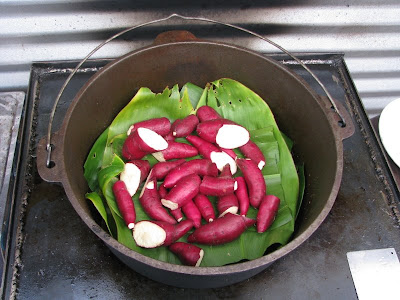
The U'ala Piko sweet potatoes I can attest conservatively produce at .5 lb per square foot per year. I've 1500 square feet of those and plan to double that here in the next couple of months. The potatoes alone will give me 100% food self-sufficiency and double as a very effective cover crop. I've written about this in detail before. As well, any extra or culls can easily be put into ethanol production with relatively high yields. The U'ala is a basic and reliable survival crop that with a years efforts can bring most any homestead in the area into near sustainable status.

They're good eats too. 

You'll note above the sweet trick I'm giving away--the corrugated PVC roofing made into 12 foot hot houses. Perfect solution for my area building greenhouse space--bug, slug, vog and chicken proof for a 1 buck a square foot. I grow perfect greens in these and it makes my previously difficult crops flawlessly successful. It would be impossible to greenhouse for less money. Besides, you're growing in real soil so the flavor--and nutrition is much higher than anything one could possibly produce in a hydroponic situation. Here I am again, giving away a million dollar idea. . .ah well, what the hell. Beets, carrots, and spinich in those in the pictures, and the herb garden on the left. 

God, I can grow some honking big sweet potatoes up here. . .that sucker in my hand must weigh 4 lbs.


Here's an interesting read. . .

http://culturechange.org/cms/index.php?option=com_content&task=view&id=325&Itemid=1